Translating Regulation into Executable Systems
Designing an AI-assisted system to transform how complex tax rules are authored, validated, and deployed at scale.
Designing an AI-assisted system to transform how complex tax rules are authored, validated, and deployed at scale.

RuleGen transformed tax rule authoring from a manual, knowledge-heavy process into a human-in-the-loop, AI-assisted workflow designed for scale and compliance.
Per rule file over time
Target, exceeding industry LLM baselines
On institutional knowledge which encompasses 90% of Rule authoring
Operational and compliance risk reduced through structured review
This work established a foundation for onboarding 40% of rule files by end of 2026, enabling future AI-assisted compliance capabilities.
Sept–Dec 2025 - Led design and launch of Lexa, an AI-assisted rule authoring experience, delivering MLP under a 3.5-month timeline for compliance-critical workflows.
Lead UX Designer
Experience Strategy · Human-AI Interaction · UX/UI ·
Research · Branding
Defined the end-to-end authoring experience, balancing AI automation with human oversight to enable a scalable, trustworthy, human-in-the-loop compliance system.
Amazon operates in hundreds of tax jurisdictions worldwide, each governed by unique and frequently changing legislation. Translating these regulations into executable tax rules is a high-risk, manual process.
Today, tax experts must:
This work is time-consuming, error-prone, and heavily reliant on institutional knowledge. In some regions, a single regulatory update required 100+ hours of combined PM and authoring effort, slowing production deployments and increasing compliance risk.
As Amazon continues to expand globally, regulatory change is no longer an exception, it is a constant.
Manual rule authoring does not scale with:
Delays or errors in tax rules can lead to incorrect tax calculation, compliance exposure, and customer trust impact. Improving this workflow is not just about efficiency, it directly affects business continuity and regulatory confidence.
Advances in large language models created an opportunity to re-imagine rule authoring.
"The goal was not to remove humans from the loop, but to move effort upstream, from manual creation to informed validation."
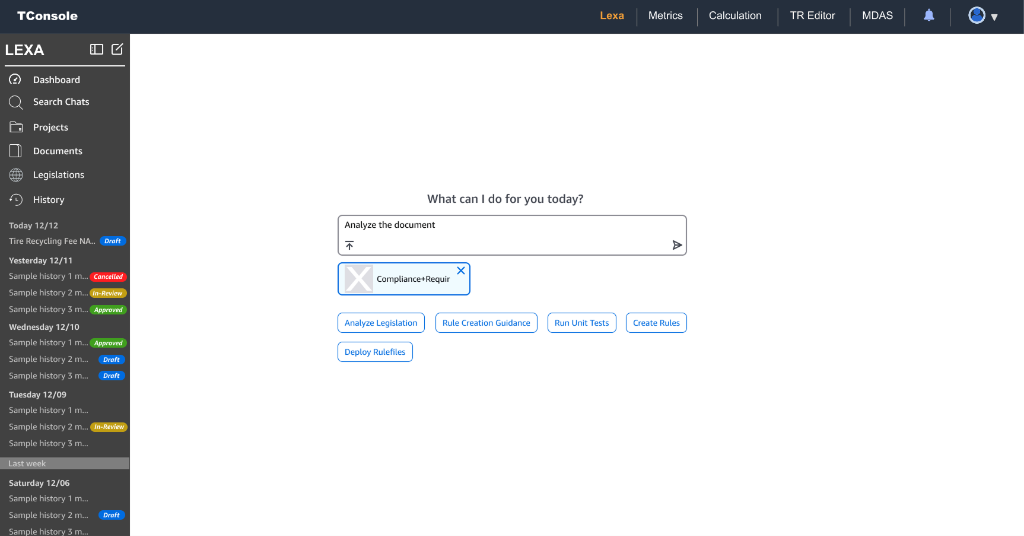
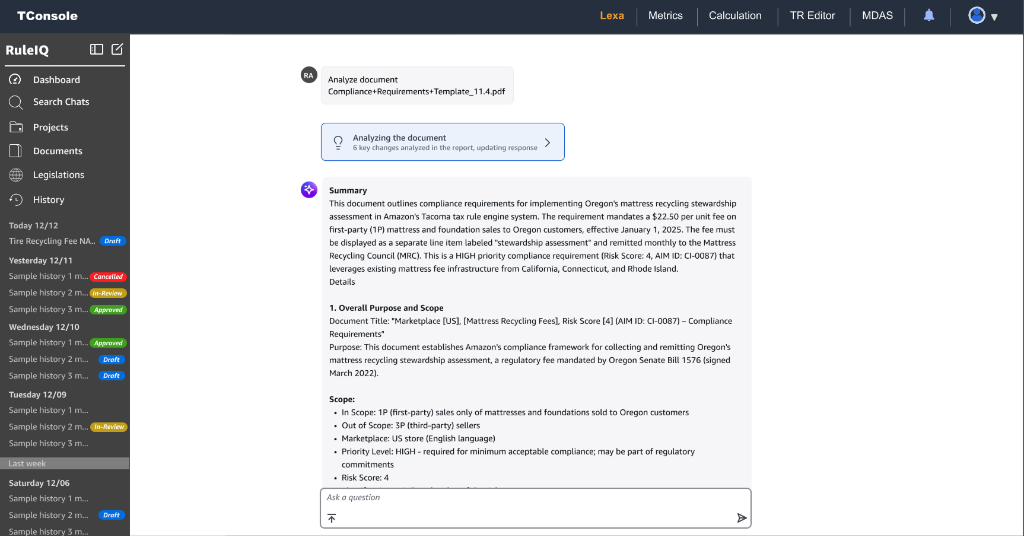
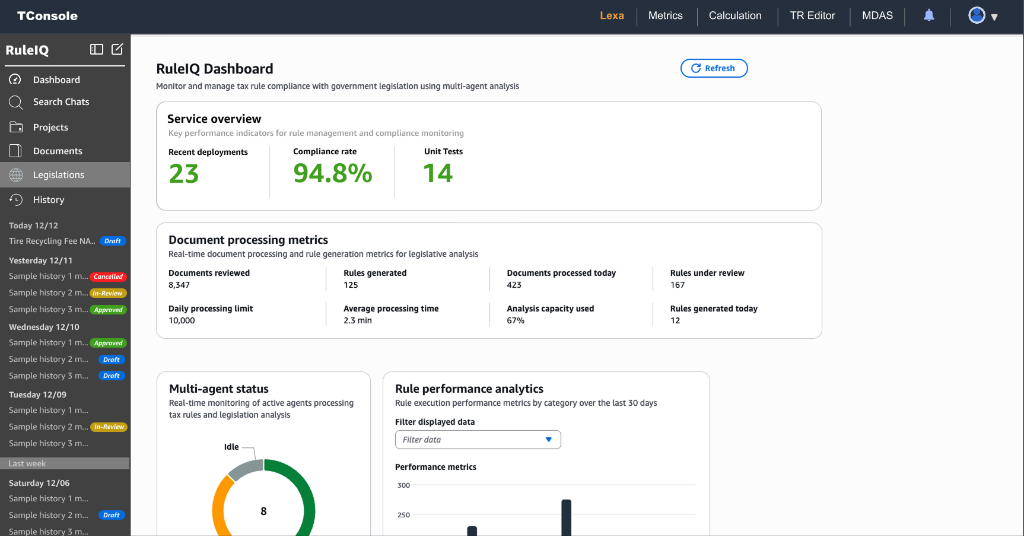
RuleGen is an AI-assisted rule authoring system that helps tax experts translate legislation into structured, executable rules with confidence.
Using a multi-agent AI architecture, RuleGen:
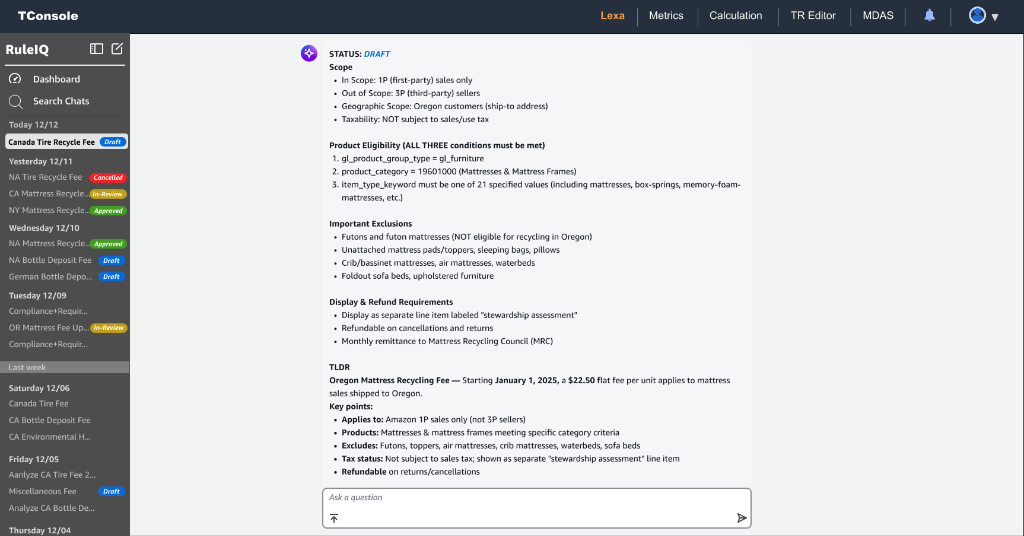
All generated rules remain editable, reviewable, and never auto-deployed, ensuring governance and control remain with the author.
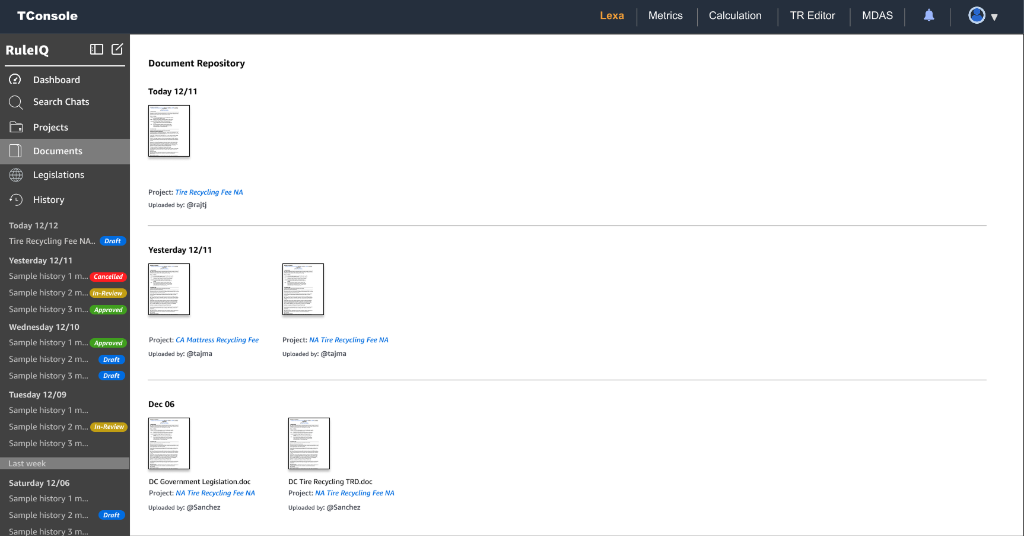
Tax experts upload legislation and interact via natural language, using a familiar chat paradigm that reduces training time.
Legislative summaries and generated rules are traceable to source logic, building confidence in AI outputs.
AI acts as an assistant, ensuring all rules remain editable and require explicit human approval before deployment.
Our initial concept placed the chat interface side-by-side with the existing rule authoring UI.
During design reviews and early feedback, we discovered this approach created serious usability issues:
We pivoted to a full-screen chat experience, allowing users to:
This change significantly improved clarity and reduced error risk—critical in regulated workflows where accuracy matters more than speed.
The next phase of RuleGen focuses on depth, memory, and auditability.
Planned enhancements include:
This re-imagined UX was reviewed with business stakeholders to align on direction and investment priorities.
RuleGen is part of a broader roadmap toward an AI-powered tax compliance assistant.
The long-term vision includes:
This roadmap guides product decisions through 2027, evolving RuleGen from a rule authoring assistant into a comprehensive compliance intelligence platform.
We are actively testing RuleGen with expert tax users.
Lexa established a scalable operating model for regulatory rule authoring, one where AI initially operates with human oversight, but is designed to progress toward autonomous execution as confidence, accuracy, and safeguards mature. The work reframed rule creation from a manual translation task into a system capable of automated interpretation, validation, and controlled deployment.
More than an MLP launch, Lexa laid the foundation for AI-assisted and eventually AI-driven, compliance workflows by proving that transparency, traceability, and progressive autonomy are prerequisites for safely removing humans from the loop, not barriers to it.