ReFlow

Simplifying Refunds for Shipping Partners

Amazon’s legacy address-validation process for identifying tax-exempt Shipping Partners was error-prone, leading to $12M+ annual under-collection and over 120K customer-service contacts. Refunds required cumbersome manual emails, taking 35% longer and generating 39% repeat contacts, eroding customer trust.

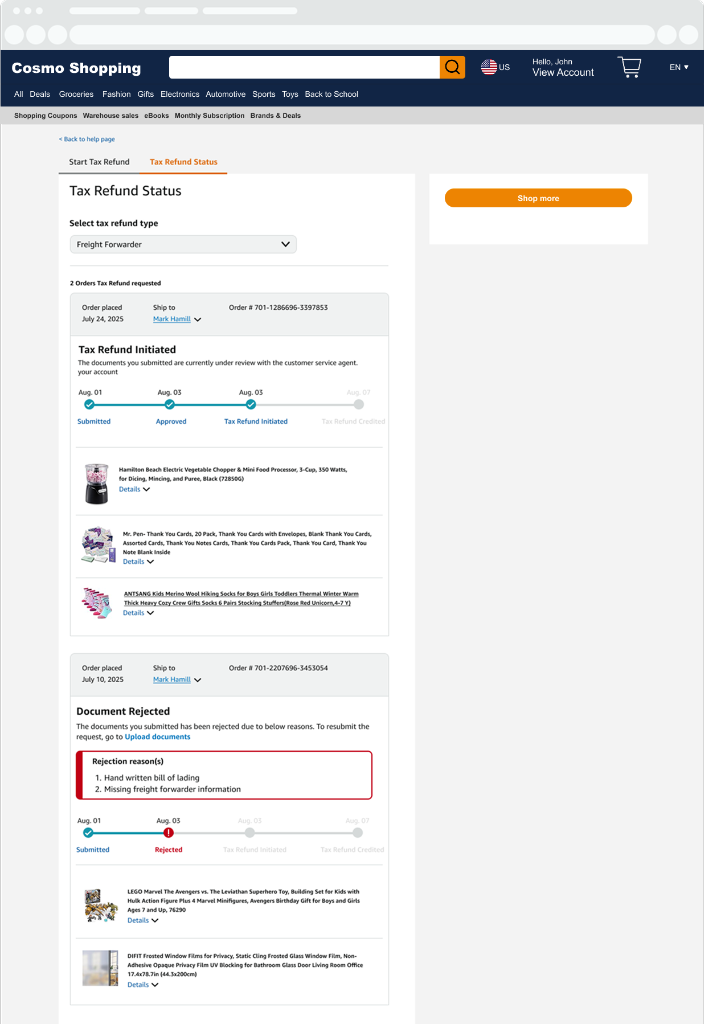
ReFlow Interface

IMPACT

20% reduction

In refund-related contacts, delivered through improved checkout accuracy and automated exemption validation.

99% precision

At checkout (95% for complex cases), significantly reducing misclassification-driven refunds.

80% reduction

Enabled for remaining contacts via Phase 2 self-service workflow, designed for guided resolution.

Timeline

2025–2026 - ReFlow modernized Amazon’s tax-exempt refund experience through a phased rollout, improving checkout accuracy and introducing a scalable self-service refund model.

Role

Design Lead - Experience Strategy, UX/UI, Cross-Org Integration

Scope & Responsibility

Owned the end-to-end customer experience for tax-exempt refunds, aligning automation, human review, and operational workflows to reduce customer friction and service dependency.

Defining the Refund Experience Strategy

  • Defined the product vision and designed customer-facing refund workflows, clarifying refund vs. return paths and reducing user confusion.
  • Partnered across Customer Experience, Customer Service, Your Account, and Payments to integrate ReFlow seamlessly into existing Amazon systems.
  • Co-led user research and usability testing with Florida-based Shipping Partners (with PM), achieving a 70% positive response rate and validating design direction.
  • Iterated on guidance content and interactions by introducing visual document examples and simplifying submission flows based on testing insights.
  • Established post-launch monitoring dashboards to track adoption, contact volume, and user drop-offs,directly informing optimization and the Phase 2 self-service roadmap.

Case Study — Deep Dive

Problem Statement

Amazon’s legacy address-validation system struggled to accurately identify registered Shipping Partners, resulting in $12M+ in annual tax misclassification and 120K+ customer-service contacts.

Refunds depended on manual, email-based workflows requiring multiple documents and validations, leading to:

35%

Longer resolution times

39%

Repeat contacts for the same issue

Erosion of customer trust and rising operational costs. Meanwhile, competitors offered automated, self-service refund experiences, creating a measurable risk to customer satisfaction and competitive parity.

Challenges

Low accuracy

Outdated address-matching logic frequently misclassified tax-exempt Shipping Partners.

Fragmented experience

Refunds were handled outside Amazon’s ecosystem through manual email exchanges and offline reviews.

Lack of transparency

Customers had no visibility into refund status, progress, or resolution timelines.

Operational strain

Manual document validation significantly increased Customer Service workload.

User confusion

Refund requests were often mistaken for product return flows, leading to misrouting and delays.

Solution

Phase 1 — Automated Exemption Validation

(Launched November 7, 2025)

Integrated MILAAP v2 canonical address-matching, achieving:

  • 99% precision for standard addresses
  • 95% precision for complex address cases
  • Established automated monthly synchronization with state-level registration data to ensure ongoing accuracy
  • Replaced brittle, rule-based legacy logic with a verified, data-driven automation model
Outcome: Reduced refund-related service contacts by ~20% while significantly improving tax-exemption accuracy at checkout.

Phase 2 — Self-Service Refund Portal

(In development, launching 2026)

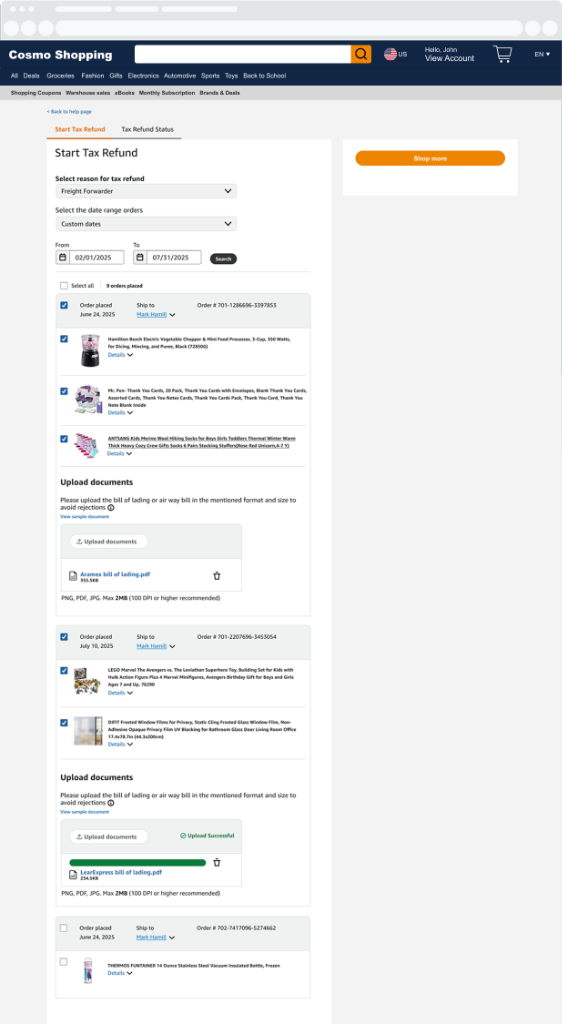
Designed a unified, self-service refund experience accessible via Your Account and Customer Service Help. Enables customers to:

  • Select eligible orders
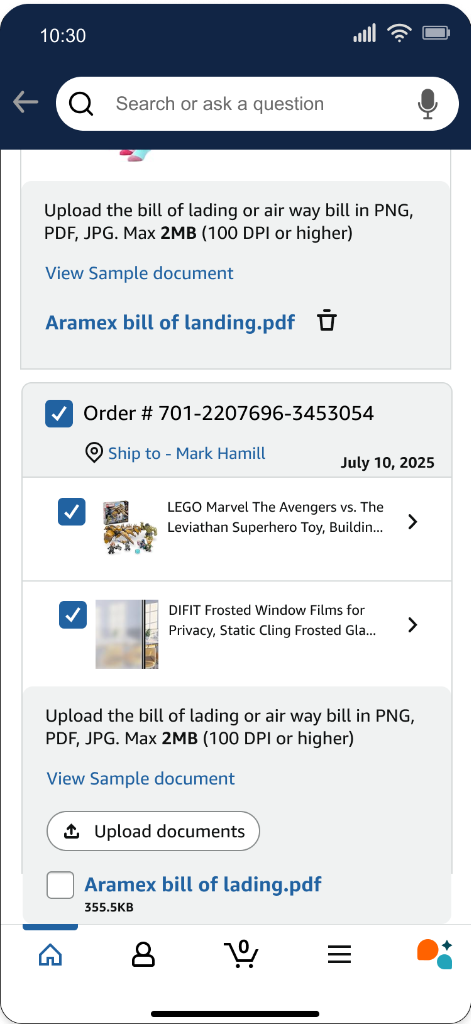
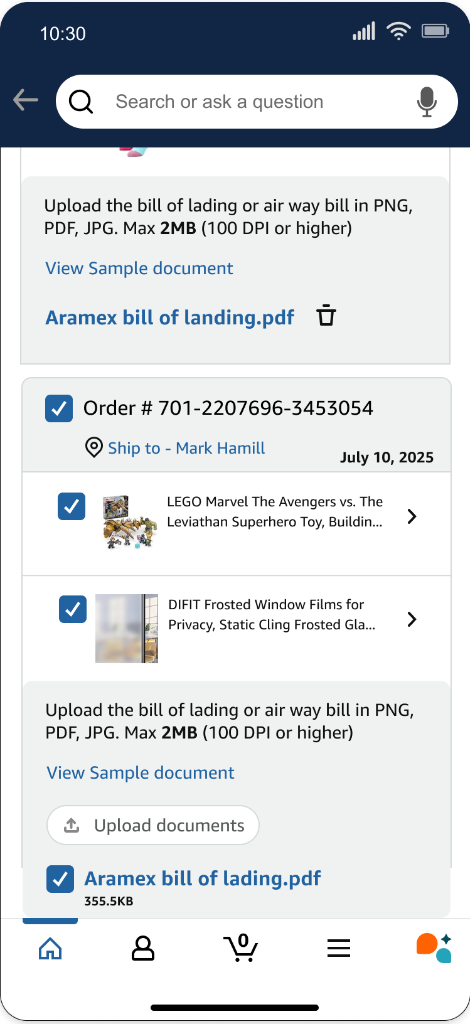
  • Upload required documentation (Airway Bill, Bill of Lading, etc.)
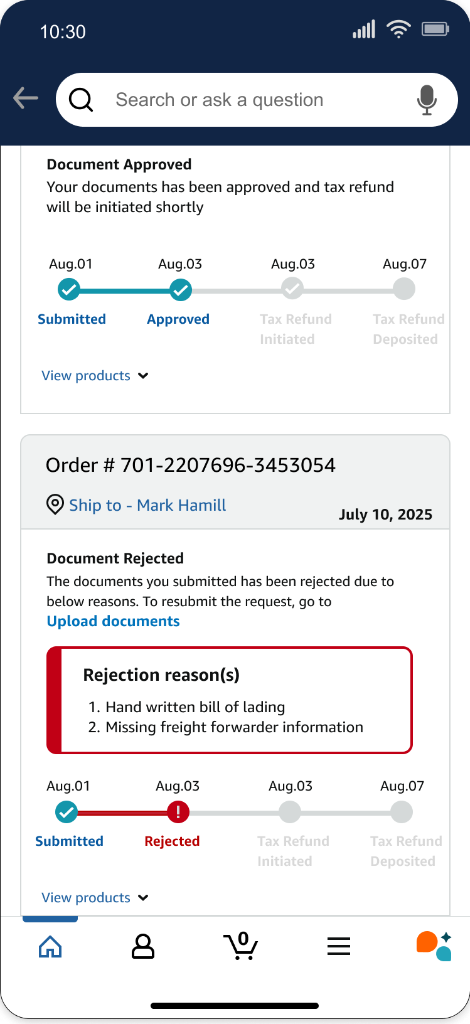
  • Track refund progress through a real-time status indicator

Key capabilities:

  • Automated notifications at critical milestones
  • Intelligent document validation to minimize manual review
  • Eligibility gating to prevent misuse and reduce downstream exceptions
Projected impact: Eliminate 80% of remaining refund-related contacts, while delivering a faster, more transparent, and trust-building customer experience.

Key Benefits

Operational efficiency at scale

A 20% reduction in refund related contacts in Phase 1, with Phase 2 designed to remove up to 80% of remaining service demand.

High-confidence accuracy

99% checkout precision (95% for complex cases) significantly reduced tax misclassification and downstream refunds.

Built-in transparency

Status visibility and proactive updates reduced follow-ups and repeat contacts, historically 39% for refund cases.

Scalable, reusable framework

A modular refund and validation architecture that can extend to additional tax and compliance use cases.

Restored customer trust

Clear guidance, predictable workflows, and self-service control improved confidence in financial outcomes.

Design

Desktop version

Mobile version

What This Work Revealed

  • Accuracy upstream prevents volume downstream Improving checkout precision (99% accuracy) proved far more effective than optimizing post-purchase recovery.
  • Transparency reduces repeat contacts Visibility into refund status addressed a key driver of repeat inquiries (previously 39%).
  • Self-service scales better than staffing A guided, eligibility-aware self-service model is the only sustainable path to eliminating the remaining 80% of contacts.
  • Phased delivery builds trust Early measurable wins (Phase 1) enabled confidence and adoption for larger behavioral change in Phase 2.